

Ordering Chaos: Deadlines, Checklists, and Dubbing
On how deadlines and lists can help organize creative processes much more than one might think.

📌 Here’s what you’ll find in this article:
A reflection inspired by Every Tool’s a Hammer, by Adam Savage
Why deadlines can be a creative tool, not just external pressure
How lists and checklists help organize complex processes
A personal look at my beginnings in quality control for Discovery Channel
A connection with the current challenges of digital dubbing and AI
👉 If you’re interested in how one learns to listen to, evaluate, and organize dubbing, this article is for you.
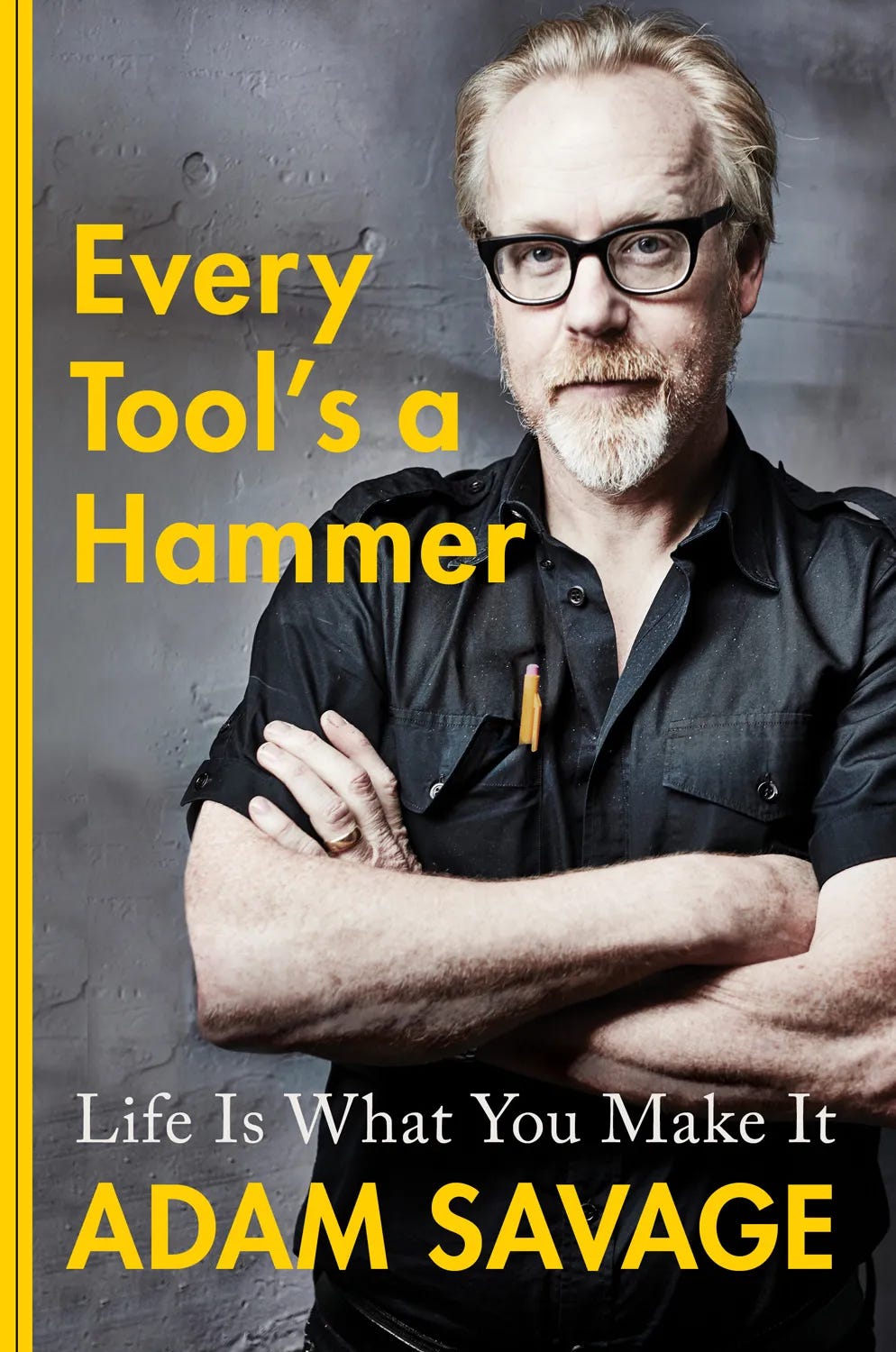
I finished reading Every Tool’s a Hammer, by Adam Savage, and several ideas stayed with me. It is a book about creative processes, about our relationship with tools, with our workspace, with mistakes, with obsession, and with the need to find some way of organizing everything that happens when we try to make something. I highly recommend it.
Although I will probably come back to several of those ideas at some point, this time I want to focus on two that resonated with me much more than I expected: deadlines and checklists.
On deadlines, Savage says:
“I LOVE DEADLINES! They are the chain saw that prunes decision trees. They create limits, refine intention, and focus effort.”
I really liked that image, because it describes quite accurately something that happens in any creative process, but becomes especially clear in dubbing. A line can be solved in many different ways, a scene can be adjusted from several angles, a quality issue can have different causes, and if we don’t find some way to organize all those possibilities, the work can quickly become unmanageable. Not because there are too few options, but precisely because there are too many.
And that brings me to something I want to connect with my own beginnings in this profession.
My first professional contact with dubbing was through quality control for Discovery Channel. I didn’t start by directing or adapting scripts, but by reviewing material for many hours a day, with a Betamax, the dubbed audio linked through an ADAT, and a paper form where every issue had to be recorded.
I’m talking about six, seven, sometimes eight hours of programming a day, reviewing sync, audio, pronunciation, translation, performance, or mixing issues, and trying to place each thing in its corresponding category.
Here is a QC form I still use today, quite similar to the one I started with back then.
At that time, of course, I didn’t think about it in a particularly sophisticated way. It was the work that had to be done. There was a form, it had categories, and those categories had to be filled in as accurately as possible. But looking back, I realize that this way of dividing material into specific types of problems ended up shaping much of the way I still think about dubbing today.
Because a category is not just a checkbox to fill in. It may seem that way, especially when you are just starting out, but over time it becomes a tool that helps you look more carefully. It forces you to ask what kind of problem you have in front of you.
If something is not working, is it an adaptation issue? Is it a performance issue? Is it a sync problem? Is the text fine but the intention wrong? Is the acting good but the audio not properly integrated into the mix? Does the line sound strange because it was mistranslated, or because no one would actually say it that way in that context?
That separation helps, first of all, because it prevents you from forgetting things. And that alone is already a lot. But it also does something that, to me, is even more important: it turns a large, confusing, and often subjective problem into a series of smaller, more analyzable parts.
The interesting thing, of course, is that those parts are never completely separate. It took me years to really understand the relationships between one thing and another. A problem that appears on the form as sync may be caused by an adaptation that is too long, or because the actor takes too much time, and so on. A performance intention that doesn’t quite land may come from a poorly built line. A mix that feels strange may be amplifying a previous problem with rhythm, pauses, or energy.
Categories help organize things, but the real work is understanding how they connect.
And that brings me back to Savage, because the chapter on checklists goes very much in that direction too. Lists are not presented as a cold way of mechanizing the creative process, but as a way of freeing up mental space. If I have a list, if I have checkboxes, if I have an order, I don’t need to hold everything in my head at the same time. I can rely on a structure that helps me move forward without losing sight of what matters.
I think this explains why those of us who have worked in quality control often end up developing a very particular way of listening. We don’t only listen to determine whether something is “right” or “wrong.” We listen for relationships. We try to understand what is happening, where the problem begins, how serious it is, whether it actually affects the experience, or whether it is simply something that could be better. And that difference, which may seem small, changes everything.
Something similar happens with deadlines. A deadline is also a tool for organization, even if we often experience it only as pressure.In a dubbing project, practically everything is perfectible: you can review one more time, adjust one more line, try another structure, ask for another take, move an entrance slightly, or keep discussing whether a problem should or should not be flagged.
But at some point, the process has to close, and that closure is not always the enemy of quality. Sometimes it is exactly what allows us to make decisions more clearly.
Not because a deadline works magic, or because every rushed delivery is good, but because it forces us to distinguish between what truly affects the result and what belongs to the endless territory of “this could also be improved.” And that distinction is central in adaptation, direction, and quality control.
That is also why I found it interesting to connect these ideas with Giselle Spiteri Miggiani’s work on quality assessment tools for AI-generated dubbing and voice-over.
I have already been recommending it, and I am not bringing it up because it says exactly the same thing as Savage, but because I think it validates from another perspective something many of us have been observing in practice for a while: to properly evaluate dubbing, and even more so when automatic generation tools are involved, we need clear criteria, useful categories, and a way of looking that does not reduce everything to “it sounds good” or “it sounds bad.”
The text specifically proposes thinking about quality assessment in these new contexts of AI-generated dubbing and voice-over, and it is well worth reading in full.
Maybe that is why those chapters of the book struck me so much. Not because they revealed something entirely new to me, but because they put into words an intuition I have been carrying for years: that the most useful tools for thinking through a creative process are not always the flashiest ones. Sometimes they are a form, a list, a deadline, a well-chosen category, or a question repeated many times until it starts organizing what seemed confusing.
And perhaps that also explains why I still believe that quality control, when properly understood, is not only a correction stage. It is a kind of training. A way of learning how to look, listen, separate, connect, and decide.
In my case, all of that began with a Betamax, an ADAT, and a paper form. Quite far from any current discussion about artificial intelligence, digital dubbing, or automation. But the further I go into those topics, the clearer it becomes to me that many of the mental tools we need to evaluate what is new come from having properly understood what came before.
I hope you enjoyed it and found it useful.
Thank you so much for reading.
This is not the chapter from the book, but here is an article by the same author where he talks about checklists. https://www.wired.com/story/adam-savage-lists-more-lists-power-checkboxes/
Este newsletter siempre será gratuito, pero si consideras que el contenido merece apoyo, te invito a colaborar conmigo a través de estos botones. Los primeros tres son para suscribirte mensualmente en pesos, a través de Mercado Pago. (Recuerda que puedes darte de baja en cualquier momento si así lo deseas). Y si estás en el exterior puedes hacerlo a través de PayPal (También con una suscripción mensual o un único aporte). Tu contribución será una forma de respaldar mi trabajo y ayudar a que este proyecto siga creciendo.
Por favor, si no puedes hacerlo no te vayas, ¡Corre por mi cuenta la invitación para que sigas leyendo!
Y MUCHÍSIMAS GRACIAS A LOS QUE YA ESTÁN COLABORANDO.